For now, we choose the time
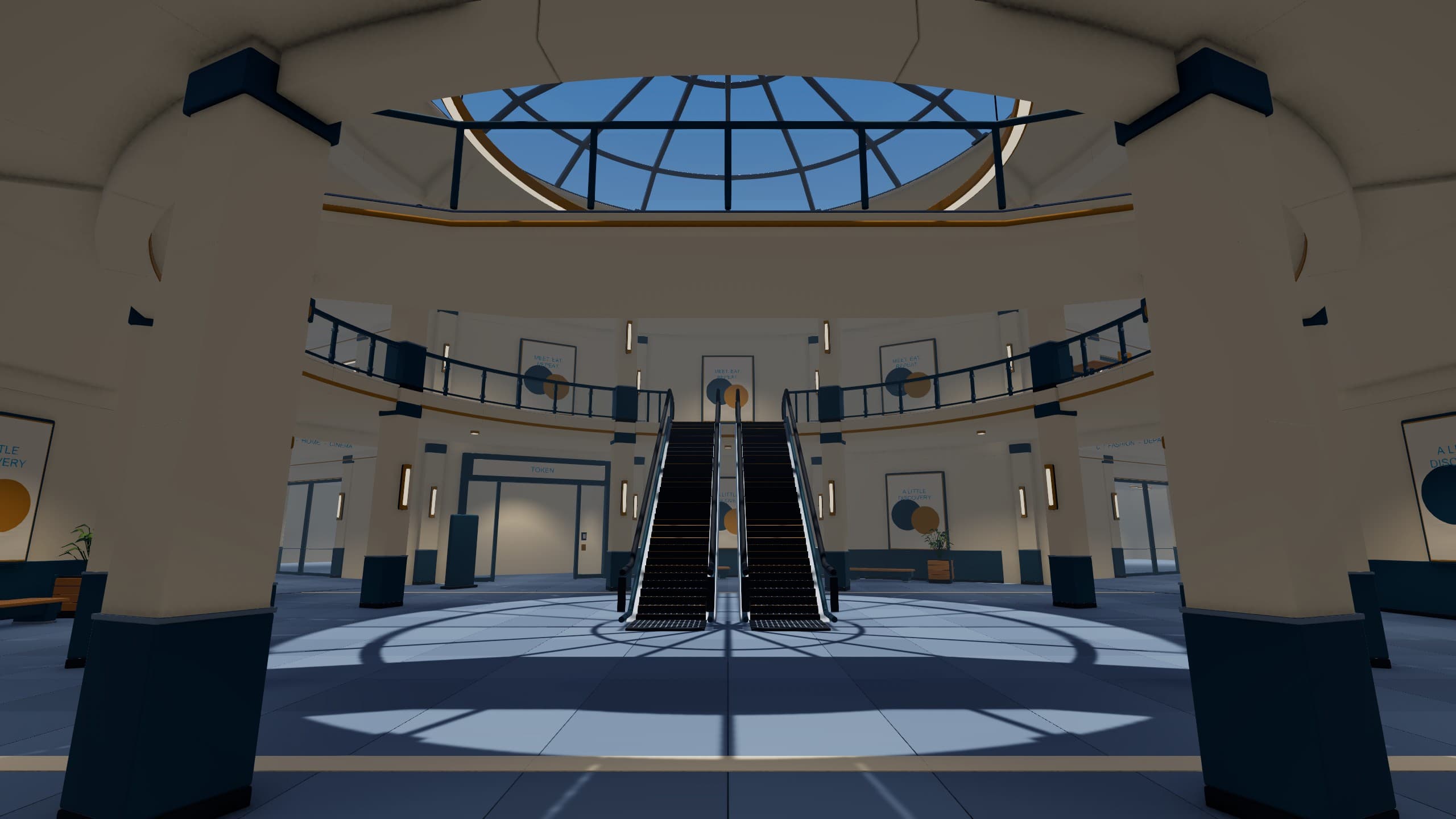
A temporary console in the atrium offers eight preset times spanning midnight through the evening. Buttons step forwards or backwards by fifteen minutes or an hour to try the times between them. Changing the selection updates the sun, sky, ambient colour, fog and reflections together, giving the same atrium a different appearance at noon and at night.
This is a manually controlled environment test. Time stays at the selected setting; an automatic day-and-night cycle or a calendar linked to shift duration is not part of it yet. The comparison photographs keep the camera in the same place so the change can be seen without a different composition.
Each store has its own switch
Lighting can be controlled independently for 21 stores. A switch does more than turn off ceiling fixtures: glowing surfaces, the store’s ambient light and label visibility change too. Products become harder to read in the dark, while an item carried into the corridor receives the lighting of its new surroundings.
The lights-on and lights-off comparison in PULSE shows this behaviour. During this work, overlapping wall surfaces that left a side wall bright after the lights went out were separated. Room-based lighting remains under development; the current appearance does not mean final lighting and performance acceptance are complete.
A shutter checks its path
Shutters on 31 doors gather above their entrances as they open. When closing, they pause if a character, another player or a physics object is underneath. Display windows remain separate, so closing a doorway does not turn the entire shopfront into a solid wall.
Target selection for light, shutter and clock controls was also revised. A held item or the player’s own body no longer needlessly blocks a button; approaching from the side and using controls while crouched were addressed too. Reach and visibility checks remain, so operating a switch through a wall is still off the rota.
Sharing the same mall state
In a shared session, the host manages time, light and shutter changes. A player joining later receives the current state too. Local tests used separate applications to check connections, normal control commands and late joining. Offline save and resume also restored the world, its evening setting and the PULSE blackout.
These results are not an acceptance test between two physical computers over the internet. Long sessions and larger player groups still need validation. The aim in 0.29 is for everyone looking at the same mall to see the same light and the same shutter. Who finishes the work list left in the dark remains a team decision.
Source document date: 11 October 2026